Tagged: All Posts

Office news

Office news. 

A new version of open office is available.  The main improvements are:

Enhancements to the open-source productivity suite include support for PDF and XHTML exports and improved compatibility with Microsoft Office, according to the OpenOffice Web site. The new release, for example, will support forms conversion within Word documents and import text document layouts with more fidelity. OpenOffice 1.1 also boasts enhanced support for mobile device formats such as Palm’s AportisDoc, Pocket Word and Pocket Excel.

IBM has ideas of its own, taking a thinner approach with its WorkPlace products

A wild card in the Office wars is IBM, which plans to offer server-based word processing, spreadsheet and presentation functionality to buyers of its WebSphere portal. At the very least, that could allow large customers to negotiate better Microsoft Office pricing/licensing, observers said. (See IBM Plans Sneak Attack On Microsoft Office.)

The MS Office team are majoring on quality for their next release, does this imply major changes, requiring major testing, or just good practice?

Software development, especially for a product as feature-rich as Office, is a repetitive process comprising what can seem to be endless feedback loops and rework.

“We’re trying to reduce the iteration of …

Architecture Lifecycle

HP have posted a short article on the role of the Architect throughout the IT project lifecycle.  I like the perspecitive as often the dominant role of the Architect is the “design” role, and this is the one that is most repeatable and easy to capture in methodology.  The following...

Getting things done

Atlantic published an article about the tools and techniques promoted by David Allen the author of the book Getting things done, which I read a few months back.  I liked the book and gave it a quick review here.  However for a better introduction its a good idea to read the article.  I have repeated a small snipit of it here to get you started.

The doctrine that inspires this devotion starts with the idea that the difference between done and undone tasks is more stress-inducing than most people recognize. In earlier times, Allen says, work was more physically exhausting than it is today. But it produced less anxiety; because people could easily tell what they had to do and whether it had been completed. Either the wood was chopped or it was not. The typical modern day, he says, is a fog of constantly accumulating open-ended obligations, with little barrier between the personal and the professional and few dear signals that you are actually “done.” E-mail pours in. Hallway conversations end with ‘I’ll get back to you.” The cell phone rings. The newspaper tells you about movies you’d like to see, recipes you’d like to try, places …

Some progress in server infrastructure for processing XML documents.

Its interesting to see the slow but sure emergence of middleware to exploit XML documents.  Microsoft have WSS which can manipulate Infopath docuemnts stored in its document libraries for example.  InfoWorld report on a mor ambitious tool from IBM, code named Project Cinnamon, you can get the full details here, but here is the real content:

Cinnamon was born in IBM’s Almaden Research Center and is a tool designed to automatically create mappings among different forms of data. By allowing users to define how an XML document gets mapped into a database such as DB2, the technology makes it easier to store those documents and to manage their content.

The upcoming utility hopes to address one of the thornier problems associated with XML-based development. Although XML serves as a clear standard for how content in a document is defined, the schema or definition of that content can be markedly different from document to document. This makes it impractical to place thousands of different documents in even a single data source and be able to retrieve certain data using a single search engine, an IBM representative said.

InfoWorld also says:

Some analysts think the upcoming technology can play a central …

The five top objections to open-source

Computer World has an article on this topic, most of which has already been debated many times with simillar answers to the ones that CW gives.  However I repeat the list here, because item 5 on the list is actually new to me:

  1. Support availability

  2. Functional limitations of the software

  3. Software license terms

  4. Rapid software release cycles

  5. Package road maps or future plans

Items 1 to 4 are answered pretty well, and I don’t think are a major concern now for most companies and the service offerings are developing at a rapid rate.  However here is the answer to item 5:

Package road maps or future plans are important to most companies. Major vendors tend to heavily promote their road maps, even to the extent of publicizing future capabilities years in advance. Of course, there is no promise that any advertised feature will ever see the light of your computer display. Not all vendors publish such road maps, and some share them only with strategic accounts under nondisclosure agreements.

Some open-source groups publish road maps, and some do not. At times, the stated goal is to mimic the functionality of a commercial package, though when any particular feature will appear …

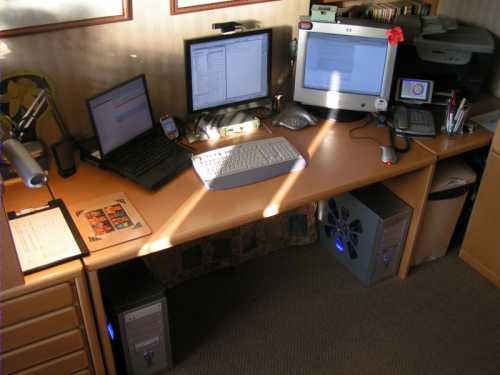
My Home Office

In another post I am going to talk a bit about why I think multiple monitors are really important, but first I want to introduce you to my home office, so you can see my personal working practice in its full context.  First things first:

  1. Everything I need is within arms reach

  2. I try to scan all my paper, and its all there in PaperPort, see below

  3. I have two desks, a computer desk where I have my three monitors, and drive all my clients and servers from one keyboard and mouse and a layout, reading etc desk where I have space to organise.  The kids use this desk at night if I am happy to be disrupted a bit.

  4. I have a web cam on top of my primary display, again more on that later

So what does it all look like.  First the nerve centre:

One large desk with three monitors and one keyboard and mouse

The Main display, a 19″ flat screen running @ 1280*1024.  This is where I do all of my reading and writing.  Its a fab display very bright and crystal clear.  Its DVI connected to my main server, which runs Windows 2003 …

Some background on NewsGator and Syndication

Some background on NewsGator and Syndication. 

This post by Brad Feld, a Venture Capitalist who has recently invested in NewsGator is useful if you too have invested in a copy and want to understand a bit about where the tool is going.  But its also interesting if like me you want to understand a bit about syndication in general and the market opportunity as investors see it.  I recently posted on how I see the market from a technical perspective for behind the firewall corporate environments, in discussion with NewsGator this market is certainly in their plans.

Greg adds a bit more detail in his blog

Yet More on PowerPoint

More PowerPoint posts continue to catch my eye.  The first is from Brad Fled, a venture capitalist who has recently invested in NewsGator,  Brad writes:

I’ve looked at thousands (tens of thousands?) presentations pitching new businesses since the mid 1990’s. The vast majority of them suck. Unfortunately, it’s not Powerpoint’s fault (no – it wouldn’t be better if Freelance has become the standard).

Brad points us to:

 Edward Tufte – a master of The Visual Display of Quantitative Information, thinks Powerpoint is evil and corrupts absolutely

He also gives us a good outline presentation for pitching to a VC, which is definately worth checking out if you ever have the need.  In fact its a good start if you need to make a pitch for any kind of investment.

The experience trap

David Chappell, a professional speaker, who often works for Microsoft has written a very interesting little article on the subject of the experience trap.  In essence, as you get more experienced, especially in IT, that experience can cause you problems as well as give you an advantage.  He recalls discussions with computer science professors who are debating which programming language a person should be taught.  Here is an extract in his own words:

The difficulties faced by teachers of computer science provide one example of the problems experience can cause. But the challenge certainly isn’t limited to professors—we’re all in danger. And since the experience trap isn’t much of a problem at the beginning of a career, it can sneak up on you. When you’re twenty five, you don’t rely much on experience because you don’t have any. When you’re forty five, however, it’s tempting to rely too much on experience. The truth is that experience is useful only if the future is like the past. In software, what will be important next year is often very, very different from what was important last year. Realizing that a significant part of our hard-won knowledge becomes valueless every year is …

More on PowerPoint

Powerpoint seems to be cropping up all over in my blogs at the moment.  I am a big user of PowerPoint.  I recently checked my local machine using X1 and I have 669 PP files at the moment.  Anyway I was pleased to come across this post by Michael Hyatt...