Tagged: Productivity

Listening to your documents

One of my friends (Simon) who doesn’t have a blog sent me this article which I though would be a really great post on using text to speech software…. For those of us who spend more than half an hour driving to work each day you may have sometimes wondered...

Office 12 and Beyond – Real time collaboration

Main themes: Reduce cost, including travel and communications expenses Time to market, how to get breakthrough ideas to market faster Distributed teams, how do I get a global organisation to act in concert Connect people, especially customers and suppliers Access to information and people 4 key capability areas, which are...

Productive Friction and Innovation

FrictionIn some recent discussions I have been introduced to the concept of “productive friction”, which is an effect that’s created when team members with a diverse background get together.  It happens for example when people from different cultures or academic disciplines or companies work together to solve a problem and it increases the level of innovation.  John Hagel describes it in his book The Only Sustainable Edge and in his Article in the Harvard Business Review.

This recent article in Newsweek describes the effect,  and gives some practical and simple advice on how to take advantage of it in your projects:

What they found was that the most successful teams did two things right. First, they attracted a mixture of experienced people and those who were newcomers to whichever field they were in. That’s not surprising–the need for fresh blood has long been recognized as an important ingredient in success. The second criterion, though, was far less obvious. What successful teams had in common was at least a few experienced members who had never collaborated with each other. “People have a tendency to want to work with their friends–people they’ve worked with before,” says Luis Amaral, a physicist at Northwestern …

Sametime vs Office Communicator

Ed Brill has an interesting post indicating that Microsoft and IBM are on the same track with respect to integrating an IP Soft Phone and the Instant Messaging and presence client.  I am looking forward to it!

IBM is teaming with Avaya to help make businesses more agile, responsive, and productive through the seamless integration of audio and collaboration tools. This integration will introduce “click-to-call” capabilities, enabling businesses using IBM(R) Lotus Notes(R) and Domino(R) and IBM Lotus(R) Sametime(R) to instantly place a telephone call to an instant messaging or email contact while remaining in their inbox or instant messaging client. By selecting multiple names, users will be able to “click-to-conference” for faster decision making and problem solving. IBM will also be integrating audio conferencing provided by Avaya Meeting Exchange with Lotus’ Web conferencing solutions, giving Web conference participants a visual indication of who is speaking and the ability to dial out to new participants, mute lines and control volume, among other capabilities.

As I understand it IBM are releasing an API for integration some time soon, and this announcement is of one partner who is implementing that API,  but I may be wrong.

I am about to get very interested in Lotus Notes, Domino and Workplace …

and IBM’s vision for its equivalent Office System using OpenOffice.org as the client.  I am also interested in tracking integration between Microsoft Office and Domino/Workplace.  Stu is my guru in this area.  I am off to Redmond next week for 3 days on the Office System v12 and meeting some of the Product Managers on Friday so it will be interesting to compare.

Always on <> productive

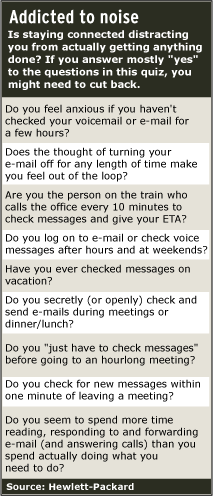
Noisead_chart2_213x496Now that I am always on, ie I have wireless (GPRS) access to most of my applications from my Tablet and my Treo I need to take care not too get dragged into the perils of “always on” addition.  The panel on the right, gives some insight into the issues courtesy of HP. 

When I had a Blackberry I felt the urge to check emails way too often for example, very similar to the addiction to e-Bay that my wife had but has now well and truly broken. 

My strategy is fairly simple, when mobile:

  • Switch off the notifications on my Treo
  • Gather the information I need onto my Tablet in advance, so I can focus on the tasks I intend to work on and don’t connect – and get distracted – unless I really need to
  • Only check my email when I have otherwise dead time,  have been away from my desk for a few hours, or get a phone call trigger that requires me to make a response

My strategy at home:

  • Switch off notifications
  • Make sure I make a plan each day – the tasks on the plan are the priority, not the email
  • Don’t have email …

0ffice 12, a lot of responsibility rests on its shoulders

CollaborationAccording to Microsoft figures:

Office 2003 appears to be falling behind in targeted sales for this point in the product’s lifecycle, according to Microsoft’s own internal figures and guidelines. Just 15% of PCs are running Office 2003, two years into its life, with Office 12 – the next edition of Microsoft’s ubiquitous suite – now on the horizon. However, Microsoft traditionally expects between 50% and two thirds of customers to be running the previous version of Office when the new copy ships. …

obviously Office 2003 is not going to catch up, which means that Office 12 is going to have to make up a lot of sales, and will also be critical to stimulating enterprises to upgrade to Windows Vista , as most enterprises upgrade both the office suite and OS at the same time.

I am off to Redmond on Sunday for a 3 day briefing on Office12 so we will see if it lives up to the challenge.

How to deal with burn-out

FireIts pretty rare that I get burnt-out, partly because I am pretty aware of my workload and the pressure I am under, but also because I have this sort of unwritten – until now – strategy:

  • I encourage a peer group support culture,  help other people when they are struggling and they might help you when you need help
  • I am honest about how I am feeling and am not afraid to have a good moan
  • I speak up when I don’t agree with something,  but know when to give in
  • I don’t keep lists,  I know if its important I will remember and if its not I will forget.  The ability to forget stuff thats not important or urgent means I rarely feel overwhelmed
  • If I struggle sleeping, (because of work), that means there is a problem, do something about it the very next day
  • I try to develop a relationship with my manager along the lines of – I’ll do my best for you, so long as you are there when I need you
  • I keep good records and am pretty professional
  • I break rules (but not important ones) or find ways around problems
  • I operate on the principle of assumed responsibility (if …

Teaching and learning

BrainsurgeryPassionate is fast becoming one of my favorite blogs – and the graphics are great too!  This post is no exception, it provides some great tips for trainers and teachers, and some great insights for anyone needing to communicate in general.  The introduction goes like this:

I’m amazed (and more than a little disheartened) how many people believe that simply by virtue of their being skilled and knowledgeable in something, they’re implicitly qualified to communicate, mentor, teach, or train that thing. It devalues the art of teaching to think that because you’ve been a student, you can teach well. That because you’ve experienced learning, you can craft a learning experience.

The post then talks a little about the fact that people can be self taught:

nobody needs a PhD (or in most cases — any degree at all) in education or learning theory to be a good teacher. Just as there are plenty of great software developers and programmers without a CompSci degree. People can be self-taught, and do a fabulous job, for a fraction of the cost of a formal education, but they have to be motivated and they have to appreciate why it’s important

which I have definately …